
Why You Should Move From AngularJS To Angular
AngularJS entered a 3-year Long Term Support on July 1, 2018. Consequently, developers were left in the lurch as it is now considered deprecated, and the move to Angular is being encouraged.
Our team decided to undertake this migration as part of the Stay Current initiative, an Accenture programme that ensures we are working with the latest and most optimal technology. We dived into this move and unearthed the pros and cons of the entire migration process. And now, we will walk you through our learnings in this series of blogs.
Before we look at the how of things, let us consider the why. Why should you take the leap from AngularJS to Angular?
The evolution of Angular1.x has enhanced the creation of dynamic single-page applications (SPAs) and remedied the cons of JS architecture with a varied range of benefits.
THE BENEFITS:
Enhanced performance:
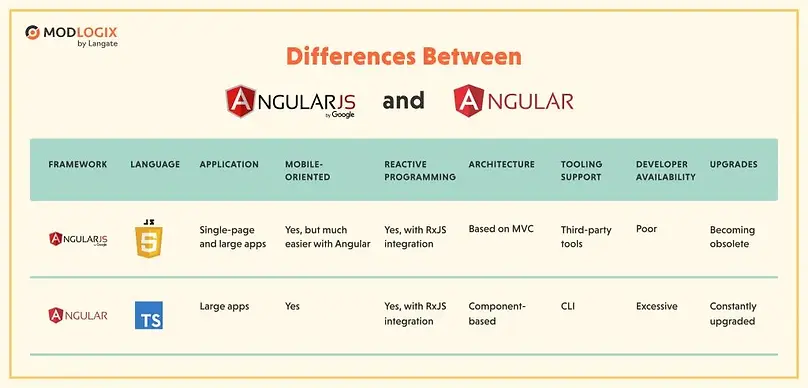
Angular is 5x faster than its predecessor, as the code on AngularJS is slower for large applications due to increased scopes and bindings. The new rendering engine, Ivy, on Angular promises faster compilation, reduced bundle size, better debugging, and more flexibility. It even offers backward compatibility on top of this.
Component-Based Architecture:
AngularJS has notions of scope and controllers, while the Angular apps are component-based and easier to comprehend. Consequently, the JS avatar is relatively rigid and less reusable.
Angular architecture is comprised of components and services that replace the views and controllers of AngularJS. The result? Improved testability and maintainability due to the reuse of elements.
Modularization:
Another benefit contributing to the ease and swift performance of Angular is the modules. You can separate code into different units as per their specific granular purpose, ensuring their easy placement and recovery. This approach produces smaller chunks of code. When navigating one route only, its relevant chunk will be loaded, resulting in faster load times.
Mobile Design:
Another plus is its mobile-driven approach. Using the strategies of mobile-oriented frameworks such as Nativescript, it allows one to create native apps with a significantly lower memory ask on devices. This, combined with the framework’s improved modular performance, enables the mobile application to run more smoothly than if it had been developed by AngularJS.
Tooling Support:
The Angular Command Line Interface (CLI) enables you to create with a simple command on your terminal, while AngularJS relies on third-party tools. This offers reduced production time, and development teams can include Angular entities such as files, components, modules, services, and directives, even a new Angular project, to eliminate the need to create all basic configurations.
Language
Angular offers the consistency and flexibility that comes with the TypeScript language. While AngularJS uses JavaScript, this meant dealing with the absence of type-checking and compile-time errors would slip through undetected. Runtime errors are reduced as they are found before transpiling.
It is also backward compatible with JavaScript, so you gain higher security and can identify errors at an early stage while writing the code. Overall, the code is optimized, and one can work across multiple platforms.
The migration from AngularJS to Angular will help you create improved user interfaces, accompanied by progressive web apps, the ability to reuse code, and access to new versions every few months courtesy of a time-based publishing cycle.